LUIZA FLYNN-GOODLETT
POET / EDITOR
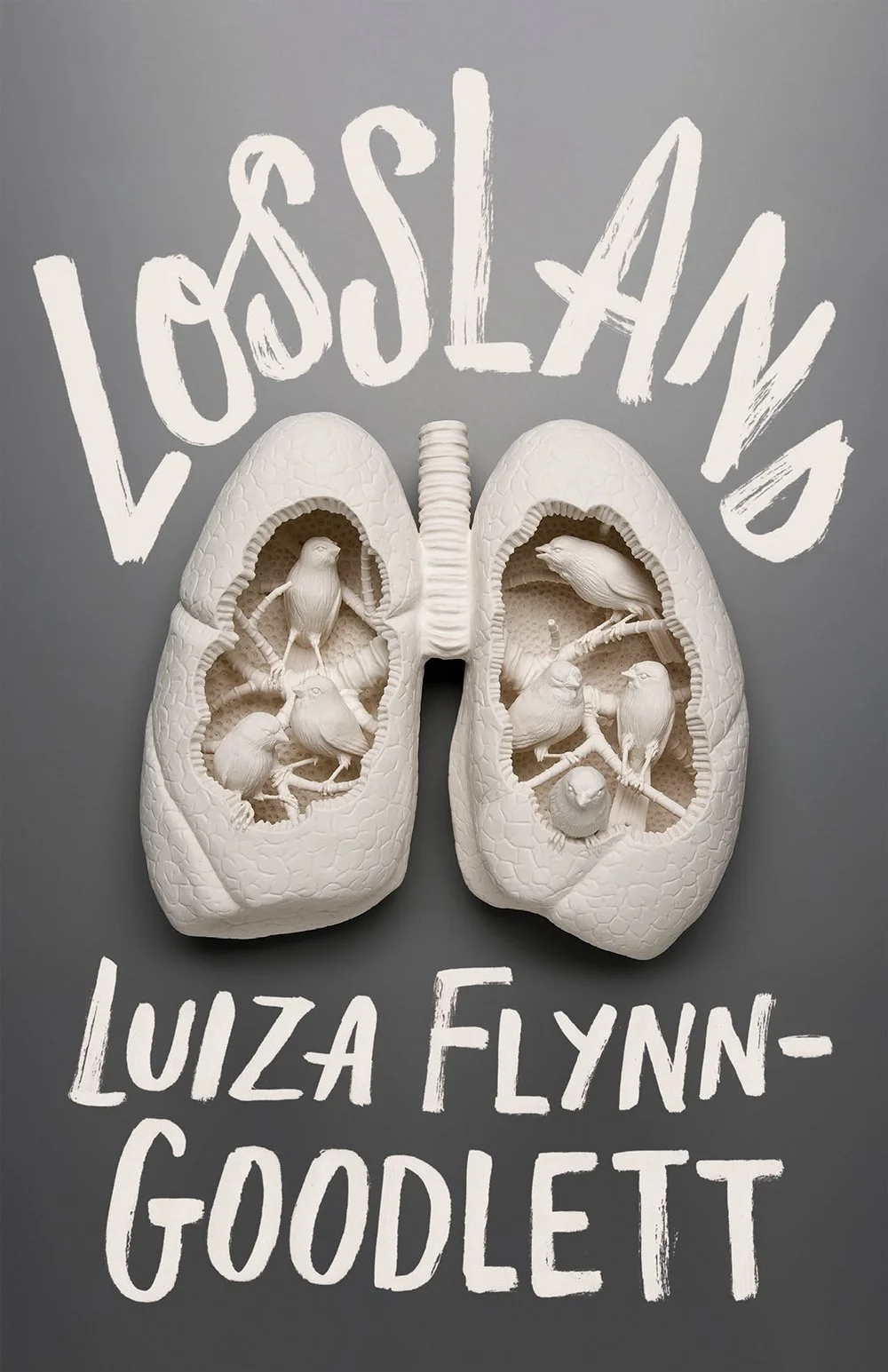
LOSSLAND
You find yourself in the midst of an overwhelming and ambiguous loss—someone you deeply loved was suffering in ways you never imagined and left your life suddenly and irrevocably. In the depths of grief, Lossland appears, an unseen breeze rustling pages, so you follow its choose-your-own-adventure-style prompts, but the end of your journey is always just out of reach. To read Lossland is to sift through an endless junk drawer of memories, hold each up for examination, and then return them to the dusty depths. But as soon as fingers scrape wood, you find yourself back at the beginning. You can’t resist. Lossland falls open on your lap. The game begins.
PRAISE
“The past—weightless / as a marble—is all we // have” writes Luiza Flynn-Goodlett in the astonishing, openwork griefsong of Lossland. Flynn-Goodlett’s speaker stands outside of time, combing out in a holographic cycle of interlacing couplets an unforgivable understanding of the circumstances that reduce an airtight we to a startlingly clear-eyed I: “I remember for // both of us now, bend /over sentences.” The process of refiguring a self in respect to a lost we—figuring out how to use any pronoun so that it has meaning in either history or the present, and what kind of space must be constructed in language in order to allow any form of address—is the project of all aftermath, but Flynn-Goodlett reminds us that for poets, the project of sounding out language that cannot go where it must is the most unyielding command of all.
—Rae Gouirand, author most recently of The Velvet Book (Cornerstone Press, 2024)
“I remember for both of us now,” writes Luiza Flynn-Goodlett in the wrenching, extended monologue of Lossland, whose poems track grief made rare: matchless, unaccounted, still pink in the middle. As much a lyric summoning as a queer archive of those disappeared by mislabeled wounds, Flynn-Goodlett turns couplet after couplet into a string of invocations: “A telegraph won’t do, / the passenger pigeon’s // extinct, and I’m all out / of stamps.” Gripping & full of stalwart faith, Lossland keeps picking up one side of the tin can telephone—hoping the string hasn’t been cut, inviting new alternatives at the end of each page—to make its own remarkable reply.
—Meg Day, author of Last Psalm at Sea Level (Barrow Street, 2014)
READ ONLINE
[You lift the sunset's] [So I'll reach underground] [It's enough to know], Tupelo Quarterly, 2026
[Tomorrow I’ll wake] [It’s Perseids season], diode poetry journal, 2025